
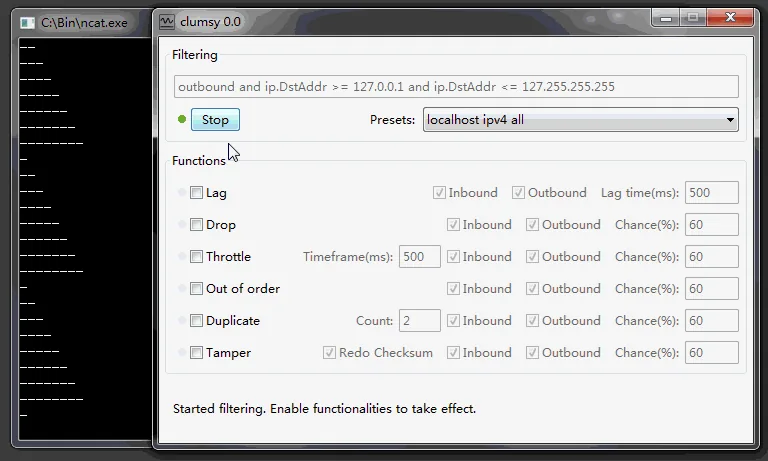
Use Clumsy 0.3 from github.com/jagt/clumsy/releases for the clearest official provenance. Do not run a 0.4 or 0.6 file until you can verify its repository owner, source changes, build process and checksum.
01
What the official Clumsy release history contains
The jagt/clumsy Release list contains the final 0.3 release, several 0.3 release candidates, version 0.2, 0.2 RC1 and version 0.1. The latest final release is 0.3, published October 21, 2023. It provides Win32 and Win64 A/B/C ZIP archives.
No 0.4, 0.4 v2 or 0.6 tag appeared in that official Release list during this update. The repository may contain commits after the final release, but commit activity does not create a numbered binary release by itself. A third party can build or modify source and choose its own label; that label does not become official without publication by the project owner.
For a normal QA or development environment, 0.3 is the strongest baseline because its source repository, release notes, assets and official project website all connect to the same owner.
| Version label | Status in jagt/clumsy | Recommended treatment |
|---|---|---|
| 0.3 | Latest official final release | Recommended verified baseline |
| 0.3 RC4 | Official release candidate; binaries described as identical to 0.3 | Prefer stable 0.3 tag |
| 0.2 | Official older release | Use only for historical reproduction |
| 0.4 / 0.4 v2 | No official release found | Treat as unofficial until fully verified |
| 0.6 | No official release found | Treat as a third-party label |
02
Why Clumsy 0.4 v2 and 0.6 appear in searches
Open-source software can be forked and modified. A maintainer may add hotkeys, change defaults, bundle different WinDivert files or package the program for a particular community. Third-party download sites may also assign a version label for their own archive. Search engines then surface the label even though it is not part of the original project's release history.
Some results frame Clumsy primarily as a lag tool for games. That context can produce modifications intended to manipulate network behavior rather than test an application responsibly. A popular video, forum thread or file-hosting page does not provide the same evidence as a source repository, documented diff and reproducible build.
Version inflation is another possibility: a higher number makes a file appear newer. Do not let the number replace provenance. Identify who created the file, what changed and whether the binary can be reproduced from visible source.
03
How to verify an unofficial Clumsy build
Begin with the repository owner. A fork should name its maintainer and link to source. Compare the fork against jagt/clumsy to identify changed files and commits. Look for release notes that explain the purpose of each change and a build configuration that another reviewer can reproduce.
Then connect source to binary. A downloadable executable without a corresponding source tag or build instructions is difficult to audit. Record the asset URL, exact byte size and SHA-256. Check whether the archive adds an installer, updater, account prompt, advertising component or unrelated executable that the official portable distribution does not need.
Finally, evaluate intent and policy. A legitimate internal modification may still be prohibited on a managed device. A build designed to bypass game controls is outside the authorized reliability-testing scope of this site.
- Identify the maintainerConfirm the repository owner and project history.
- Compare source changesReview the diff from official jagt/clumsy.
- Reproduce the buildRequire documented tools and steps when possible.
- Record the binarySave asset URL, bytes and full SHA-256.
- Review purpose and policyReject bypass, disruption or unauthorized-use goals.
04
Risk signals in a Clumsy download
Stop when a page claims to be official but cannot link to a matching jagt/clumsy release. Be cautious when a ZIP is replaced by a custom installer, password-protected archive or download manager. Requests to disable all security protection, add exclusions broadly or conceal the process are material risk signals.
A checksum posted by the same anonymous uploader is not independent verification. The value is useful only when it can be tied to a trusted maintainer or reproduced from source. Likewise, a clean result from one scanner is not a guarantee; network tools can produce both false positives and real concerns that require technical review.
Avoid builds marketed as undetected ping hacks, Roblox exploits or anti-cheat bypasses. Besides ethical and account risks, that distribution context gives a malicious packager a strong reason to hide behavior.
- No source repository or maintainer identity.
- No documented diff from the official project.
- Custom installer for software normally distributed as a portable ZIP.
- Instructions to disable security without explaining a specific reviewed detection.
- Claims of being undetected or intended to bypass game controls.
- Version number absent from the official release history.
05
Why Clumsy 0.3 remains the recommended download
The official 0.3 release provides a documented feature set, source repository, release notes and six architecture/signature assets. Its Win64 A and Win32 A archives can be verified with exact byte sizes and SHA-256 values. That evidence is more valuable than an unsupported claim that another file is newer.
Version 0.3 includes bandwidth support, updated IUP and WinDivert dependencies, RST support, drop-throttled behavior, more accurate chance handling and a higher Lag ceiling. It is sufficient for the latency, packet-loss and general weak-network testing workflows documented on this site.
If the official project publishes a future release, this site should update version facts only after confirming the owner, tag, date, assets, release notes and checksums. Until then, 0.3 is the honest default.
It does not mean the largest version number found on a file-hosting page.
06
Version choice does not change responsible-use rules
Whether a build is official or modified, Clumsy affects live network traffic. Use it only on systems, applications and networks you own or have explicit permission to test. Keep filters narrow, record settings and restore normal connectivity after every run.
This site does not evaluate unofficial builds for cheating performance and does not publish bypass instructions. The correct use case is reproducible software reliability work: testing loading states, retries, reconnection, idempotency, streaming degradation and recovery under controlled conditions.
When a required feature is absent from official 0.3, consider whether an established network-testing alternative or a transparent internal build is more appropriate than an anonymous repackaged executable. Provenance and supportability are part of the tool decision.
FAQ
Clumsy version verification FAQ
Is Clumsy 0.4 an official release?
No Clumsy 0.4 tag appears in the official jagt/clumsy Release list checked July 20, 2026. Treat the label as unofficial until its source is independently verified.
What is Clumsy 0.4 v2?
It appears to be a third-party or community label rather than an official jagt/clumsy release. Review the specific maintainer, source diff and checksum before considering it.
Is Clumsy 0.6 newer than 0.3?
The number is higher, but no official 0.6 release appears in the original project history. A higher label does not prove official provenance or safer code.
Can I download older official Clumsy versions?
The official GitHub Release history includes 0.2 and 0.1 assets. Use them only when a historical test specifically requires an older environment.
How will this site handle a future official release?
The version, publisher, tag, date, assets, release notes and checksums should be verified from jagt/clumsy before homepage download links or metadata change.